The Miami Marlins' Dee Gordon is chasing this year a feat that has only been accomplished by the Uber-Hall of Famers Ty Cobb, Honus Wagner and Brownie George Sisler. That feat is leading the major leagues in both batting average and stolen bases.
Monday,
August 17 -vs. San Francisco Giants, 7:15 pm
Take a step
back in baseball history and join us for St. Louis Browns Night - August 17,
2015 - at Busch Stadium. The St Louis Browns played in Sportsman’s Park from
1902-1953 and are a rich part of St. Louis baseball history. Fans who purchase
a special Browns Night Theme Ticket will receive a limited edition Browns cap.
Fans can also enjoy other Browns-related activities and special guests that
night as well.
Join your
fellow Browns Fan Club members to cheer on our St. Louis Cardinals. If you wish
to sit in the St. Louis Browns Fan Club section, we have a hold on 100 tickets
in the Left Field Porch. The price right now is $35.80 which includes the
limited edition Browns cap.
To order as
part of the STL Browns Historical Society group, please call Christine Goodman:
314-345-9512. NOTE: If you wish to purchase tickets in a different section,
please visit: www.cardinals.com/theme or call the ticket
registration service at 314-345-9000. Mention the Browns Fan Club.
If you're not
a member, join the Browns Fan Club and receive a replica scorecard from 1947
when the Browns and Cardinals played each other in their spring training St.
Louis “City Series.” You will see the names of great Cardinal players during
that time such as Stan Musial, Red Schoendienst, Marty Marion, Whitey Kurowski,
Terry Moore, Joe Garagiola, Joe Medwick, Enos Slaughter and others.
The ‘47 Browns
players listed include Denny Galehouse, Bob Muncrief, Less Moss, Johnny
Berardino, Bob Dillinger, Vern Stephens, Hank Thompson, Al Zarilla, Jack Kramer
and others. During the 1947 season, Dizzy Dean pitched one game for the
Browns which was the last game of his career. All of these players for both
teams are listed in this scorecard. Get yours today.
ØTo
order tickets on-line, go to http://cardinals.com/theme.
ØTo
order tickets by phone, call 314-345-9000.
ØTo order tickets for the Browns Fan
Club Section, call Christine Goodman at 314-345-9512
ØTo
join Browns Fan Club and receive the Cards/Browns City Series scorecard, call
314-892-8632.
ØTo
obtain City Series Scorecard, donate $10. Send check to St. Louis Browns Fan
Club, PO Box 510047, St. Louis MO 63151
For
information on the STL Browns Fan Club, e-mail or call:
Bill Rogers -
stlbrowns@swbell.net
Bill Rogers -
314-892-8632
- - -
Note -
Tickets, caps, scorecards, hot dogs, Cracker Jack, etc. are all limited.
Reserve early.
100 years ago this week, the Daily Journal-Gazette of Mattoon, Ill., reported in their April 30 edition:
MATTOON -- The St. Louis Browns baseball club of the American League will pass through Mattoon on the Big Four Railroad the morning of May 2.
Rickey
I shall leave it to our readers in the railroad buff community to explain the details of the Big Four Railroad (the name popularly given to the Central Pacific Railroad, a/k/a the first transcontinental railroad).*
The Browns were finishing up a road trip in Cleveland and heading home to St. Louis to begin a homestand Tuesday. Robert Lee Hedges, the original owner of the Browns is still owner for one last year. Still on the team is Hall of Famer Bobby Wallace, who goes all the way back to the St. Louis Perfectos (they of "best opening record in franchise history fame"). Branch Rickey is the manager. The Browns are stagnant in 8th place.
You can peruse other stories noted on April 30, 1915, courtesy of the Mattoon Journal Gazette and Times-Courierwebsite.
I would note three things:
1. The daily newspaper was the thing, not twitter. But the amount of minutia is roughly the same.
2. The Browns are in last place, but simply being part of the "Big 8 teams" of any one of the three major leagues operating at the time, was, at least by Mattoon standards, an attraction.
3. Not sure if there is a freight rail-line still passing through Mattoon, but look at how amazingly straight-arrow it is to pass over there "as the crow flies" from Cleveland to St. Louis.
If you went by Amtrak today, you would have to go through Chicago; if you drove, through Effingham.
* Though I cant resist pointing out that the railroad had its origins with a bill introduced by Senator Thomas Hart Benton of Missouri for a "Great National Highway from St. Louis to the Pacific Ocean, straight as may be, with branches to Oregon and Mexico. The Government was to reserve a strip one mile wide for it, so as to provide for every kind of a road and means of conveyance – railway, plank, macadamized, with railroad trains, wagons, stages, pack trains and even sleds in Winter".
ST. LOUIS CONNECTION
Adam Jones is the first Orioles player to have four or more hits three times within the team's first 23 games. Since records are first available in 1914, the only other player in franchise history to do it was Baby Doll Jacobson in 1924 for the St. Louis Browns.
I always get disturbed reading that Ichiro Suzuki broke George Sisler's season record with 262 hits to Sisler's 257. No mention is ever made that the season was extended from 154 games to 162 which helped Ichciro break the record.
Ichiro had 1.62 hits per game compared to 1.67 by Sisler. Sisler had the most per game and edged him out. George is still the leader.
“Saturday Afternoon At Sportsman’s Park,” oil 1945
We at the St. Louis Browns fan club were not aware of a critically acclaimed oil painting having been done around the scene(s) of the 1944 World Series, the subway series between the Browns and the Cardinals.
But same came to our attention courtesy of the Boston Globe, which ran a feature concerning the new “The Art of Baseball” exhibit at the Concord Museum in Concord, Massachusetts.
The painting is by Edward Laning and is entitled “Saturday Afternoon At Sportsman’s Park”. According to the Globe article, it depicts Game 4 of the World Series, played October 7, 1944. (The Browns went into that tilt leading the series two games to one).
Laning, who died in 1981, is a renowned mural painter whose works are still prominent in many public buildings around the country.
“The Art of Baseball” opens this Friday (April 17)* and runs through Sept. 20. Doris Kearns Goodwin is honorary curator of the exhibit.
Perhaps Laning's most famous work is The Role of the Immigrant in the Industrial Development of America which hangs in the Aliens’ Dining Room at Ellis Island.
Laning was part of an art school called the Fourteenth Street school. Laning and the Fourteenth Streeters occupied a peculiar role among their peers. While their subjects were distinctly contemporary, their style was proudly anachronistic: they drew inspiration from European masters like Rubens, Veronese, and Tintoretto. During a trip to Europe in 1929, Laning was taken by the work of Rubens, one of Miller’s favorites.
Laning was born and raised not too far from Sportsman's Park. He was from Petersburg, Illinois in Menard County. It is not known whether Laning was a Browns or Cardinals rooter .. or even a Cubs fan.
The Boston Globe article about the exhibit opening is here.
* April 17 is also the beginning of a three-day week-end homestand in Boston against the Baltimore Orioles, the successors of the St. Louis Browns. Hopefully, more than a few Brownie/Orioles fans in town to root on their beloved O's will take in the exhibit this weekend in Beantown.
1925 — The Cleveland Indians opened the season with a 21-14 victory over the St. Louis Browns, the most runs scored by one club on opening day. The Indians scored 12 runs in the eighth inning when the Browns made five errors. Browns first baseman George Sisler had four errors in the game.
The Seattle Mariners yesterday tied a 70-year old record held by the St. Louis Browns. It is the American league record of most consecutive wins on opening day, with nine. The Browns won nine consecutive opening days from 1937 through 1945.
The Browns would have made it 10 straight, but in 1946, the Browns' Nels Potter lost a pitchers' duel to Hal Newhouser, as the defending World Champion Detroit Tigers beat the Brownies 2-1.
Back in those days, the Browns opened the season against the de facto Western Division. During their nine season record-setting span, the Browns opened against the Tigers and Chicago White Sox four times each, and the Cleveland Indians once.
Yes, the Browns were very proficient at giving their fans opening-day bliss. Rest of the season? Not so much....
The
St. Louis Browns Fan Clubwill
be represented at the St. Louis Sports Collectors and baseball card show next
show Sunday, April 12th at Orlando Gardens. The banquet center is
south of Bayless Rd and Interstate 55 in South County.
On
hand signing autographs are Lou Brock, Red Schoendienst and Jim Bunning. Feel
free to view our autograph lineup on our homepage at www.stlsportscollectors.com .
Lou Brockwon the hearts of Cardinal fans shortly after his trade to the
Cardinals on June 15, 1964. That trade helped spark the Cardinals to an
unexpected pennant and next the first World Series Championship for
St Louis.
Why was the pennant and ensuing World Championship unexpected? When the trade
was made, the Cardinals were in eighth place and as late as September 21st
the Phillies had a 6.5 game lead for the pennant! During the remainder of Mr.
Brock's career, he achieved another World Series Championship, one National
League Pennant, 938 stolen bases (then an all-time record), over 3,000 hits,
stolen base leader eight times and six time all-star. He also led the league at
various time in at bats, doubles and triples! Other achievements include having
the highest World Series batting average, .391, for those that played in 20 or
more games, he was one of only four batters to hit a home run in the right
center field bleachers in the Polo Grounds (Babe Ruth, Hank Aaron and Joe
Adcock being the others), also he was the first batter in a major league
regular season game in Canada when the Expos first played in Montreal.
The achievements of Hall of
Fame member Red Schoendienstare
many: he was an outstanding second baseman often leading the league in fielding
statistics. He was a member of the 1946 Cardinal and 1957 Brave
World Champion
Teams. He was a member of the 1958 Brave National League Champion team. Also as
a player he was a ten time all-star, often hit over .300 and even lead the NL
in base steals one year!
After retiring as a player he
managed the World Champion Cardinal team of 1967. He managed the 1968 NL
Champion team and was a coach for the World Series Champion 1964 and 1982
Cardinals! He was the bench coach of the 1985 and 1987 NL Champs. He ranks
second in wins as a Cardinal Manager. In 1967 and 1968 he earned the Manager of
the Year Award. Hope you can plan on coming out to meet the third oldest
members of the Hall of Fame and the oldest manager of a World Series Champion
team! He has been in a MLB uniform in various capacities for 70 years. Come out
to congratulate him in his 70th season in uniform!!
It has been eight years since Hall of Fame pitcher, Jim Bunning, last
appeared with St Louis Sports Collectors. The achievements of Mr. Bunning are
numerous: nine time All-Star, three time
Strikeout leader, win leader, two no
hitters, one of which was a perfect game. To put it in perspective of how
dominate he was as a pitcher, when he retired, Mr. Bunning was second on the
list of all time strikeouts, behind only Walter Johnson.
While with the Tigers, he pitched a no-hitter against the Ted
Williams led Boston Red Sox. On Father's Day, 1964 while with the Phillies, he
tossed a perfect game against the Mets. The perfect game was the first thrown
in the National League since 1880! He is one of seven pitchers to throw a
perfect game and a separate no hitter, four of those came after his. He is only
one of five pitchers to have a no hitter in each league. Lastly,on August 2, 1959, Bunning struck out three batters on
nine pitches in the ninth inning of a 5-4 loss to the Boston Red Sox. He is
one of ten pitchers to accomplish a nine pitch/three strikeout inning. His post
baseball career was also very rewarding by serving five terms in the US House
of Representatives and two terms in the United States Senate.
The St. Louis Browns’ official club photo, from 1944.
I was a thirteen-year-old baseball nut in 1948 when I discovered the St. Louis Browns of the American League. Red, white, and blue had monopolized big-league team colors since Bob (Death to Flying Things) Ferguson had cavorted for the Hartford Dark Blues decades before, but the Browns had been flouting color convention since their founding, in 1902. For the same logical reason that the Homestead Grays’ uniforms could hardly be puce or taupe, the Browns had to wear brown. A rich color, brown, but not a heroic color.
It was a perfect fit. A color scheme that evoked the barnyard and the excretions of babies fittingly defined the Browns. They were the Lowly Browns from the outset, setting all the wrong records: first in last-place finishes; leukemic attendance that reached a nadir, in 1933, when thirty-three fans paid to watch a home game; so financially strapped that scuffed, worn, and torn baseballs were put in play because the club couldn’t afford the regulation number of fresh ones.
Other than a freak World Series appearance in 1944, amid a wartime talent drought so dire that a one-armed outfielder eventually made the starting lineup, the Browns were as universally unloved a baseball team as ever existed. The National League Cardinals shared the Browns owned Sportsman’s Park with the Browns and were their opposite: perennial winners, darlings of St. Louis baseball fans. The red-white-and-blue Cards filled the park as fast as the Browns emptied it.
Which struck a resonant chord and endeared them to me, because of my own issues of low self-esteem. I identified with unloved losers in all spheres: in hockey, the then forlorn New York Rangers; in automobiles, Nash, a poor relation of Detroit’s Big Three, about to go under; in politics, Harold Stassen, the Don Quixote from Minnesota. Naturally, I despised the rich and smug New York Yankees the way Walter Reuther despised Henry Ford.
I wallowed in my Brownsophilia even after that baseball Barnum Bill Veeck took over the team, in 1951. He proceeded on the principle that stunts would be a faster, cheaper route to higher ticket sales than trying to build a winning team. It was Veeck who once sent a three-and-a-half-foot little person up to bat, who let the fans in the stands vote on strategy, who tried attracting St. Louis’s black community to Sportsman’s Park by signing the beloved grandfatherly pitcher Satchel Paige (the Cardinals stayed all-white to the bitter end).
I wallowed in Brownsophilia until that fateful day in 1953 when baseball exterminated the Browns like a roach (an ugly brown roach, natch) and the franchise morphed into, ladies and gentlemen, your Baltimore Orioles.
Yet that youthful crush abides even today. As I write this I’m wearing a sweatshirt with the classic BROWNS,” and atop it a medieval knight astride his horse, wielding a mighty sword, more Knights of Columbus heraldry than baseball iconography. (Its origins and meaning remain tantalizingly mysterious.) My sweatshirt was obtained via the official online Browns Fan Club, a hardy cell of nostalgists keeping the feeble flame alive sixty-two years after the last Brownie whiffed.
Browns logo over the heart: a shield enclosing a baseball imprinted with “
There’s even a Brownie theme song and a Surviving Players roll call. (The nifty fifties hurler Ned Garver, a twenty-game winner for a 1951 Browns team that lost a hundred and two games, is ninety years old.)
Baseball economics today have levelled out the old imbalance that kept rich teams like the Yankees riding so high and the impoverished Browns providing the flooring for the league cellar, year after year. I feel for the kid with an inferiority complex who has just discovered the game, because the sweet misery of Brownsophilia will never be his.
Hot diggity dog! Our crack St. Louis Browns Historical Society research crew has uncovered another Brownie record: In 1893, the Browns became the first team in the history of baseball to sell hotdogs to fans.
From the History of the Hot Dog over at hot-dog.org:
The year was 1893. In Chicago that year, the Colombian Exposition brought hordes of visitors who consumed large quantities of sausages sold by vendors. People liked this food that was easy to eat, convenient and inexpensive. Hot dog historian Bruce Kraig, Ph.D., says the Germans always ate the dachshund sausages with bread. Since the sausage culture is German, it is likely that Germans introduced the practice of eating the dachshund sausages, which we today know as the hot dog, nestled in a bun.
Standard fare at baseball parks.
Also in 1893, sausages became the standard fare at baseball parks. This tradition is believed to have been started by a St. Louis bar owner, Chris Von de Ahe, a German immigrant who also owned the St. Louis Browns major league baseball team.
Inventing the hot dog bun.
Many hot dog historians chafe at the suggestion that today's hot dog on a bun was introduced during the St. Louis "Louisiana Purchase Exposition" in 1904 by Bavarian concessionaire, Anton Feuchtwanger. As the story goes, he loaned white gloves to his patrons to hold his piping hot sausages. Because most of the gloves were not returned, the supply began running low. He reportedly asked his brother-in-law, a baker, for help.
The baker improvised long soft rolls that fit the meat - thus inventing the hot dog bun.
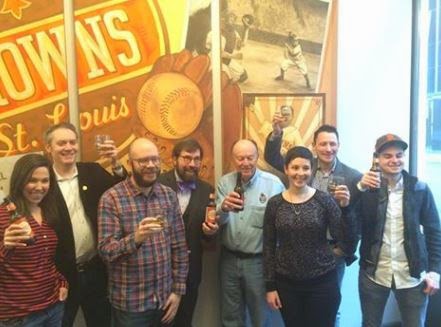
Browns Fan Club officials, Emmett McAuliffe & Bill Rogers, are the two guys right in the middle.
Others toasting the event are officials and staff from Elasticity, a digital marketing and public relations
firm and HLK Agency
(Click on Photo to Enlarge)
A new bar is set to open in downtown St. Louis* in a month or so to pay homage to the "tiny" things in life - like former Browns player, Eddie Gaedel, the shortest player in baseball history. Gaedel is part of the mural hanging on the wall in the background
Official notices and press releases will be out soon. Stay tuned. *1008 Locust Street
Roy Sievers, a regular at the annual St. Louis Browns Fan Club player/fan reunion luncheon, has become the oldest living Washington Senator (expansion franchise). This so, after the passing today of Minnie Minoso.
Roy was purchased by the Senators late in the 1964 season from the Philadelphia Phillies. This entailed for Roy moving from a first-place team to a 9th-place team. Still, Sievers performed admirably, banging four home runs in just 58 at bats. Thus he led the Senators that year in both pinch hit home runs and home run percentage.
Sievers, a St. Louisan who attended Beaumont high school, was American League Rookie of the year in 1949 as a Brown. He finished his career with the Senators in 1965, totaling 318 home runs. When Sievers retired, he was the oldest non-pitcher, non-manager in baseball (age 38.172). Roy and Minnie both played in the A.L. in the 40s, 50s and 60s. But unlike Minnie, Roy did not make "stunt bows" in the 70s and 80s to become a most-decades leader.
Several other Brownies are featured on the Oldest Living Baseball Player List. Chuck Stevens, 96, of Garden Grove, Calif., is the oldest living St. Louis professional ballplayer (Browns or Cardinals). A career Brownie, Chuck is also one of only six major league players who played before World War II.
Ned Garver, 89, is the oldest living member of the entire Los Angeles Angels franchise. Tito Francona, 81, who was signed by the Browns and played his first two years of professional baseball at the Browns' farm clubs at York and Aberdeen, is the oldest living player of two teams. First, he is the oldest living member of the Oakland Athletics. Second, Tito is the oldest-living Milwaukee Brewer (the Browns were originally derived from the 1901 Milwaukee Brewer franchise).
The St. Louis Browns/Baltimore Orioles currently have six players in the Top 25 Oldest Living Major League Baseball Playerslist:
#7 Stevens, 96
#13 Tom Jordan, 95
#20 Wally Westlake, 94 (Oriole only)
#22 Dick Starr, 93
#23 George Elder, 93
#24 Jim Rivera, 93
Today I have a special interview! It's with the Hall of Famer who has the best
lifetime batting average of all time (.366), Ty Cobb! But wait: Ty Cobb has been dead
since 1961, so how could I have possibly interviewed him? Good question.
Remember my "interviews" with Jackie Robinson and Babe Ruth, where I asked someone who knew a
lot about one of the hitters to answer questions as if he was him? Well, I did
the same thing with this interview. The person who answered my questions as if
he was Cobb is Norm Coleman, an actor who actually plays Ty Cobb on stage for
the past eight years in the play "Tyrus Cobb." Norm's answers were
awesome and I think they sound exactly like how Cobb himself would answer the
questions.
The real Ty Cobb below:
Ty Cobb
But before I present the interview, click herehttp://baseballwithmatt.blogspot.com/ . The link
will actually take you to where you can buy my book, "Amazing Aaron to
Zero Zippers: An Introduction to Baseball History, " which I highly
recommend. If you flip to chapter three in the book, you will see a whole
section on "Cantankerous (meaning argumentative) Cobb." Hope you find
the biography interesting. Anyway, let's get to the interview.
Matt: You faced a lot of tough pitchers during your playing days,
but who was the toughest to hit against? Ty: The two most difficult pitchers for me to handle were Babe
Ruth when he pitched for Boston and Walter Johnsonof the Washington
Senators. Both entered the Hall of Fame with me in 1936. The Babe threw only
two pitches, fastball, up high and in tight, and a curve, low and away. You
knew they were coming and sometimes he’d yell at me, telling me what was
coming. He dared you to hit it and if you got a hit, he’d scream at me,
"You got lucky Ty."
I went 22 for 67 with a batting average of .328
against George. No one threw faster than Walter Johnson. If they had radar guns
back then, his fastball would clock near 100 mph. Johnson feared hitting a
batter, afraid he might kill him if he hit the batter in the head. So I would
step in closer to the plate, making Walter throw a little outside, making it a
little easier for me to hit the ball to left and get 120 hits in 328 at-bats for
an average of .366.
Every hitter has one guy he can’t hit. For me, there was a
little fellow named Bill Bayne(pictured below), pitched
for the St. Louis Browns between 1919 and 1924. I faced him 36 times and got
only 5 hits, which was a batting average of .139. I never could figure him out.
Don Johnson was born Nov. 12, 1926, in Portland, OR.In high school, he excelled as a pitcher attracting the attention of major league scouts and was signed by the New York Yankees in 1943. WWII interrupted Don's early baseball career. He served two years in the U.S. Army.
Don Johnson
At the age of 20, Don made his major league debut with the 1947 Yankees, going the distance against the Philadelphia Athletics in a 10 inning 3-2 victory.
Don's professional baseball career spanned 16 years with the Yankees, St. Louis Browns, Chicago White Sox, Washington Senators, Baltimore Orioles and San Francisco Giants. He also pitched for Toronto in the International League. He led the league in ERA and strikeouts and in 1957, was named the league's MVP.v


dObcYvg--60_35.JPG)