The Baseball Reliquary Presents Baseball for the Fun of It!
Exhibition: March 5-April 23, 2011
West Covina Public Library, 1601 West Covina Pkwy., West Covina, California
Information: (626) 791-7647 or terymar@earthlink.net
The Baseball Reliquary presents Baseball for the Fun of It!, an exhibition of photographs, artworks, artifacts, and documents exploring some of the humorous and amusing events and personalities that have added much to the history and legacy of the national pastime, from March 5-April 23, 2011 at the West Covina Public Library, 1601 West Covina Pkwy., West Covina, California.
Highlights include a 60th anniversary tribute to Eddie Gaedel, the midget who came to the plate for Bill Veeck’s St. Louis Browns in 1951 in one of the greatest promotional stunts in baseball history. The infamous “Disco Demolition Night” is recalled in a series of photographs by Paul Natkin, who documented the pyrotechnic extravaganza between games of a 1979 doubleheader at Chicago’s Comiskey Park which resulted in pandemonium and hastened the demise of disco as a musical genre. The feathered orange and yellow San Diego Chicken, the pioneering mascot who transcended his character to become a virtual folk hero, is featured in a display of various personal artifacts and props from a game-worn suit to his famous eye chart for umpires.
Baseball for the Fun of It! is a must-see for those who have grown weary of the all-too-serious side of baseball and yearn for the return of some plain old fun to the game.
Library hours for the exhibition are Tuesday-Thursday, 10:00 am-8:00 pm; Saturday, 8:00 am-6:00 pm; closed Monday, Friday, and Sunday. For further information, contact the Baseball Reliquary by phone at (626) 791-7647 or by e-mail at terymar@earthlink.net.
The exhibition is made possible, in part, by a grant to the Baseball Reliquary from the Los Angeles County Board of Supervisors through the Los Angeles County Arts Commission.
Wednesday, March 2, 2011
Sunday, February 27, 2011
Hall of Fame center fielder Duke Snider dies at 84
Duke Snider, the Hall of Fame center fielder for the charmed "Boys of Summer" who helped the Dodgers bring their elusive and only World Series crown to Brooklyn, died early Sunday of what his family called natural causes. He was 84.
Snider died at the Valle Vista Convalescent Hospital in Escondido, Calif., according to the National Baseball Hall of Fame and Museum, which announced the death on behalf of the family.
"The Duke of Flatbush" hit .295 with 407 career home runs, played in the World Series six times and won two titles. But the eight-time All-Star was defined by much more than his stats - he was, after all, part of the love affair between the borough of Brooklyn and "Dem Bums" who lived in the local neighborhoods.
Ebbets Field was filled with stars such as Pee Wee Reese, Roy Campanella and Gil Hodges during that 1955 championship season. Yet it is Snider's name that refrains in the ballpark favorite "Talkin' Baseball."
"Willie, Mickey, and the Duke," the popular song goes.
More at: http://hosted.ap.org/dynamic/stories/B/BBO_OBIT_SNIDER?SITE=MOSTP&SECTION=DJSP_COMPLETE&TEMPLATE=DEFAULT&CTIME=2011-02-27-15-35-00
Snider died at the Valle Vista Convalescent Hospital in Escondido, Calif., according to the National Baseball Hall of Fame and Museum, which announced the death on behalf of the family.
"The Duke of Flatbush" hit .295 with 407 career home runs, played in the World Series six times and won two titles. But the eight-time All-Star was defined by much more than his stats - he was, after all, part of the love affair between the borough of Brooklyn and "Dem Bums" who lived in the local neighborhoods.
Ebbets Field was filled with stars such as Pee Wee Reese, Roy Campanella and Gil Hodges during that 1955 championship season. Yet it is Snider's name that refrains in the ballpark favorite "Talkin' Baseball."
"Willie, Mickey, and the Duke," the popular song goes.
More at: http://hosted.ap.org/dynamic/stories/B/BBO_OBIT_SNIDER?SITE=MOSTP&SECTION=DJSP_COMPLETE&TEMPLATE=DEFAULT&CTIME=2011-02-27-15-35-00
Wednesday, February 16, 2011
Monday, February 14, 2011
PayPal and Attorney Team Up to Rip off Baseball Historic Society
PayPal Refuses to Help Identify Card Clearing Bank, Partners With Bank to Cheat Historic Society
St. Louis, MO, February 15, 2011 - The 27 year old St. Louis Browns Historic Society says they’ve been ripped off by a Skokie, Illinois attorney using his credit card through PayPal. The attorney, Irving Funk, purchased a St. Louis Browns replica baseball jersey from the Society. He paid for the merchandise and turned around and canceled the transaction with his bank about a month later. Now three months later, the Society is still trying to have its merchandised returned.
Society President, Bill Rogers, says the baseball jersey was exactly as pictured at their blog site at http://brownsmerchandise.blogspot.com/ . “The cost of the sale does not warrant filing a lawsuit, but it does warrant spreading the word about the ethics of Mr. Funk. We have sent numerous e-mails, made numerous phone calls, and also sent post office mail but all goes unanswered. All we’re asking for is either payment of the Jersey ($72) or return of the merchandise. It’s that simple. We have no idea why Mr. Funk changed his mind.”
Mr. Funk advised his bank to stop payment of the purchase. His bank notified PayPal who refunded the money back to Mr. Funk. A call for help to PayPal has fallen on deaf ears. Rogers said, “I have talked to PayPal several times requesting they advise us as to Mr. Funk’s bank name and/or the credit card number used for this fraudulent transaction. PayPal refuses to co-operate citing privacy reasons. PayPal has become a party to this fraud.”
A Google search on “PayPal Problems” turned up over 97,000 websites. Rogers said he noted comments at http://headkeys.com/screw-paypal.com that provides help to those who got ripped off by PayPal.
One person commented, “Had an email off PayPal this morning. The buyer has filed an 'item not as described’ dispute, even though it was exactly as described and the lovely people at PayPal have now seized the money involved and frozen my account! I am going to have to go through all this dispute bovine excrement now, not knowing whether I will even get MY money back from them at the end of it all. Not sure what’s going on. Have I been the victim of a scam? Do you think?”
About St. Louis Browns Historical Society
The mission of the St. Louis Browns Historical Society is to preserve the history and memory of the St. Louis Browns baseball team. The Browns played in St. Louis from 1902 through the 1953 season. The fan club was organized in 1984 and has more than 315 members today.
To learn more about the Browns, visit their Internet sites at:
http://www.thestlbrowns.com/
http://thestlbrowns.blogspot.com/
http://brownsmuseum.blogspot.com/
http://brownsmerchandise.blogspot.com/
http://stlbrowns.qbstores.com/
Contact
Bill Rogers, President/COO
St. Louis Browns Fan Club
P.O. Box 510047
St. Louis, MO 63151-0047
Telephone: 314-892-8632
E – mail: STLBrowns@SWbell.net
St. Louis, MO, February 15, 2011 - The 27 year old St. Louis Browns Historic Society says they’ve been ripped off by a Skokie, Illinois attorney using his credit card through PayPal. The attorney, Irving Funk, purchased a St. Louis Browns replica baseball jersey from the Society. He paid for the merchandise and turned around and canceled the transaction with his bank about a month later. Now three months later, the Society is still trying to have its merchandised returned.
Society President, Bill Rogers, says the baseball jersey was exactly as pictured at their blog site at http://brownsmerchandise.blogspot.com/ . “The cost of the sale does not warrant filing a lawsuit, but it does warrant spreading the word about the ethics of Mr. Funk. We have sent numerous e-mails, made numerous phone calls, and also sent post office mail but all goes unanswered. All we’re asking for is either payment of the Jersey ($72) or return of the merchandise. It’s that simple. We have no idea why Mr. Funk changed his mind.”
Mr. Funk advised his bank to stop payment of the purchase. His bank notified PayPal who refunded the money back to Mr. Funk. A call for help to PayPal has fallen on deaf ears. Rogers said, “I have talked to PayPal several times requesting they advise us as to Mr. Funk’s bank name and/or the credit card number used for this fraudulent transaction. PayPal refuses to co-operate citing privacy reasons. PayPal has become a party to this fraud.”
A Google search on “PayPal Problems” turned up over 97,000 websites. Rogers said he noted comments at http://headkeys.com/screw-paypal.com that provides help to those who got ripped off by PayPal.
One person commented, “Had an email off PayPal this morning. The buyer has filed an 'item not as described’ dispute, even though it was exactly as described and the lovely people at PayPal have now seized the money involved and frozen my account! I am going to have to go through all this dispute bovine excrement now, not knowing whether I will even get MY money back from them at the end of it all. Not sure what’s going on. Have I been the victim of a scam? Do you think?”
About St. Louis Browns Historical Society
The mission of the St. Louis Browns Historical Society is to preserve the history and memory of the St. Louis Browns baseball team. The Browns played in St. Louis from 1902 through the 1953 season. The fan club was organized in 1984 and has more than 315 members today.
To learn more about the Browns, visit their Internet sites at:
http://www.thestlbrowns.com/
http://thestlbrowns.blogspot.com/
http://brownsmuseum.blogspot.com/
http://brownsmerchandise.blogspot.com/
http://stlbrowns.qbstores.com/
Contact
Bill Rogers, President/COO
St. Louis Browns Fan Club
P.O. Box 510047
St. Louis, MO 63151-0047
Telephone: 314-892-8632
E – mail: STLBrowns@SWbell.net
A Batter's Eye View
SPORTS COLLECTORS DIGEST FEBUARY 25, 2011 ISSUE
http://www.sportscollectorsdigest.com/article/bill_purdy_interview
By Rich Marazzi
It’s not unusual for guys my age to have a bucket list. One thing I’ve always wanted to do was to catch batting practice at Yankee Stadium – or any major league park for that matter. Since teams no longer have batting practice catchers, and my life is in fast forward, chances of me fulfilling my fantasy are slim-to-none.
I recently read an article about former St. Louis Browns bat boy and batting practice catcher Bill Purdy in Pop Flies, the official magazine of the St. Louis Browns Historical Society. Batting practice catcher? Before you could say Clint Courtney, I did my best Sherlock Holmes imitation and tracked him down. (Click on Photo to Enlarge)
Purdy, a retired high school principal and educator in St. Louis, grew up a serious Browns fan despite suffering through a dismal but colorful period in team history. A Knothole Gang member who often went to Browns’ games on weekends, he was one of the 18,369 fans in attendance at Sportsman’s Park on Aug. 19, 1951, when owner Bill Veeck employed Eddie Gaedel, the 3-foot-7-inch midget. It is perhaps baseball’s most notorious stunt that will certainly be resurrected in this 60th anniversary year.
“I was sitting on the third base side in the upper deck with a friend,” recalled Purdy. “Between games of a doubleheader against the Tigers, they wheeled a cake onto the field and out of the cake jumped Gaedel. The crowd was astounded. Frank Saucier, who was considered a rookie phenom at the time, was announced to be in the starting lineup, and I was excited about this. He was scheduled to lead off the bottom of the first and play right field. But when he came to bat, manager Zack Taylor pinch-hit Gaedel for Saucier.”
Tigers’ pitcher Bob Cain threw four “balls” while laughing through the burlesque. After Gaedel waddled down to first base wearing elf’s shoes and uniform No. 1/8, he was replaced by Jim Delsing, and Gaedel’s one at-bat big league career came to an abrupt end.
When the Browns last won a pennant (1944) Purdy was only 7 years old. The Cardinals, with marquee names like Stan Musial, Red Schoendienst and Marty Marion, owned the city. So how did he develop an affinity toward the Brownies?
“We used to play step ball,” he explained “We would use a tennis ball and throw it off the concrete steps. If you caught the ball, you stayed in the game. I used to pretend that I was George McQuinn, the former Browns first baseman.”
Born and raised in St. Louis, Purdy was a standout catcher from Little League through his days at Southwest High School. He hit like Johnny Bench but ran like Ernie Lombardi – maybe a little faster. He then played one year of baseball for Washington University in St. Louis before transferring to Southeast Missouri State College where the school did not have a baseball program.
Bat boy and bullpen catcher
Veeck, who purchased an 80 percent stake in the Browns in 1951, worked endlessly to promote his anemic franchise. After all, he had to compete with “Stan the Man’s” Cardinals who were tenants in the same ballpark.
In 1952, Veeck held a promotional essay contest in search of a bat boy for the St. Louis Browns. The winner was 14-year-old Bill Purdy. Not only was he selected to be the club’s bat boy, he won $500 and his parents were given a season pass. And in classic Veeckian style, any of the 2,500 students at Southwest High School could attend one game for free on May 17. Those who did attend saw the Browns rally for two runs in the bottom of the ninth to beat Mel Parnell and the Red Sox 2-1.
Purdy now had rock star status among his peers. Like the movie title that year starring Dan Dailey, Dizzy Dean and Joanne Dru, he was “The Pride of St. Louis” among his classmates. And thanks to an understanding school principal who was a baseball fan, he was able to get out of school for the few day games that were played.
The year 1952 was an unforgettable one for the 14-year-old bat boy and batting practice catcher. It was the beginning of the Eisenhower years, Kay Starr sang “Wheel of Fortune” and Topps printed its Cadillac 407-card set.
“My first year I was a bat boy and batting practice catcher,” said Purdy. “In ’53, the final season for the Browns in St. Louis, I was exclusively a batting practice and bullpen catcher.
“I assume the regular catchers, Les Moss and Clint Courtney, didn’t want to do it. Catching was a tough job and the St. Louis heat can take a lot out of you. Coaches Bob Scheffing and Bill Norman were very good to me. I remember Eddie Olsen, who played hockey for the St. Louis Flyers minor league team, often threw batting practice. In the bullpen, I warmed-up legends like Satchel Paige, Virgil Trucks, Harry “The Cat” Brecheen, Don Larsen, Bob Turley, Ned Garver and Tommy Byrne. I had no problem catching them.”
Veeck had a penchant for signing former Cardinals. Brecheen, who spent most of his prominent 133-92 career with the Redbirds, beat the Red Sox three times in the 1946 World Series. He pitched the final season of his career for the Browns. “The Cat” made 16 starts and came out of the bullpen 10 times, going 5-13. And would you believe his favorite bullpen catcher was the young Purdy?
“For whatever reason, one day I warmed up Harry before a game and he won,” Purdy said. “After that he wouldn’t allow any one else to warm him up.”
Purdy was especially close to Paige, the ageless Hall of Fame right-hander who spent most of his career in the Negro leagues.
“He lived in the Adams Hotel at the corner of Pendleton and Olive Streets,” Purdy said.“It was a segregated hotel about two blocks from my father’s restaurant, The Rex CafĂ©. My father would pick us up after a road trip and Satchel would often dine there. This was a time when many restaurants and hotels were segregated. My dad’s place was opened 24/7 to everyone, and celebrities such as President Harry Truman, Jimmy Durante, Jane Wyman, Kirk Douglas, wrestler “Gorgeous George,” Harry Caray and others ate there. Part of the movie The Glass Menagerie was filmed outside the restaurant.”
Purdy’s friendship with Paige grew from all this. Their close relationship would impact Purdy’s life.
Read the rest of this story at: http://www.sportscollectorsdigest.com/article/bill_purdy_interview
http://www.sportscollectorsdigest.com/article/bill_purdy_interview
By Rich Marazzi
It’s not unusual for guys my age to have a bucket list. One thing I’ve always wanted to do was to catch batting practice at Yankee Stadium – or any major league park for that matter. Since teams no longer have batting practice catchers, and my life is in fast forward, chances of me fulfilling my fantasy are slim-to-none.
I recently read an article about former St. Louis Browns bat boy and batting practice catcher Bill Purdy in Pop Flies, the official magazine of the St. Louis Browns Historical Society. Batting practice catcher? Before you could say Clint Courtney, I did my best Sherlock Holmes imitation and tracked him down. (Click on Photo to Enlarge)
Purdy, a retired high school principal and educator in St. Louis, grew up a serious Browns fan despite suffering through a dismal but colorful period in team history. A Knothole Gang member who often went to Browns’ games on weekends, he was one of the 18,369 fans in attendance at Sportsman’s Park on Aug. 19, 1951, when owner Bill Veeck employed Eddie Gaedel, the 3-foot-7-inch midget. It is perhaps baseball’s most notorious stunt that will certainly be resurrected in this 60th anniversary year.
“I was sitting on the third base side in the upper deck with a friend,” recalled Purdy. “Between games of a doubleheader against the Tigers, they wheeled a cake onto the field and out of the cake jumped Gaedel. The crowd was astounded. Frank Saucier, who was considered a rookie phenom at the time, was announced to be in the starting lineup, and I was excited about this. He was scheduled to lead off the bottom of the first and play right field. But when he came to bat, manager Zack Taylor pinch-hit Gaedel for Saucier.”
Tigers’ pitcher Bob Cain threw four “balls” while laughing through the burlesque. After Gaedel waddled down to first base wearing elf’s shoes and uniform No. 1/8, he was replaced by Jim Delsing, and Gaedel’s one at-bat big league career came to an abrupt end.
When the Browns last won a pennant (1944) Purdy was only 7 years old. The Cardinals, with marquee names like Stan Musial, Red Schoendienst and Marty Marion, owned the city. So how did he develop an affinity toward the Brownies?
“We used to play step ball,” he explained “We would use a tennis ball and throw it off the concrete steps. If you caught the ball, you stayed in the game. I used to pretend that I was George McQuinn, the former Browns first baseman.”
Born and raised in St. Louis, Purdy was a standout catcher from Little League through his days at Southwest High School. He hit like Johnny Bench but ran like Ernie Lombardi – maybe a little faster. He then played one year of baseball for Washington University in St. Louis before transferring to Southeast Missouri State College where the school did not have a baseball program.
Bat boy and bullpen catcher
Veeck, who purchased an 80 percent stake in the Browns in 1951, worked endlessly to promote his anemic franchise. After all, he had to compete with “Stan the Man’s” Cardinals who were tenants in the same ballpark.
In 1952, Veeck held a promotional essay contest in search of a bat boy for the St. Louis Browns. The winner was 14-year-old Bill Purdy. Not only was he selected to be the club’s bat boy, he won $500 and his parents were given a season pass. And in classic Veeckian style, any of the 2,500 students at Southwest High School could attend one game for free on May 17. Those who did attend saw the Browns rally for two runs in the bottom of the ninth to beat Mel Parnell and the Red Sox 2-1.
Purdy now had rock star status among his peers. Like the movie title that year starring Dan Dailey, Dizzy Dean and Joanne Dru, he was “The Pride of St. Louis” among his classmates. And thanks to an understanding school principal who was a baseball fan, he was able to get out of school for the few day games that were played.
The year 1952 was an unforgettable one for the 14-year-old bat boy and batting practice catcher. It was the beginning of the Eisenhower years, Kay Starr sang “Wheel of Fortune” and Topps printed its Cadillac 407-card set.
“My first year I was a bat boy and batting practice catcher,” said Purdy. “In ’53, the final season for the Browns in St. Louis, I was exclusively a batting practice and bullpen catcher.
“I assume the regular catchers, Les Moss and Clint Courtney, didn’t want to do it. Catching was a tough job and the St. Louis heat can take a lot out of you. Coaches Bob Scheffing and Bill Norman were very good to me. I remember Eddie Olsen, who played hockey for the St. Louis Flyers minor league team, often threw batting practice. In the bullpen, I warmed-up legends like Satchel Paige, Virgil Trucks, Harry “The Cat” Brecheen, Don Larsen, Bob Turley, Ned Garver and Tommy Byrne. I had no problem catching them.”
Veeck had a penchant for signing former Cardinals. Brecheen, who spent most of his prominent 133-92 career with the Redbirds, beat the Red Sox three times in the 1946 World Series. He pitched the final season of his career for the Browns. “The Cat” made 16 starts and came out of the bullpen 10 times, going 5-13. And would you believe his favorite bullpen catcher was the young Purdy?
“For whatever reason, one day I warmed up Harry before a game and he won,” Purdy said. “After that he wouldn’t allow any one else to warm him up.”
Purdy was especially close to Paige, the ageless Hall of Fame right-hander who spent most of his career in the Negro leagues.
“He lived in the Adams Hotel at the corner of Pendleton and Olive Streets,” Purdy said.“It was a segregated hotel about two blocks from my father’s restaurant, The Rex CafĂ©. My father would pick us up after a road trip and Satchel would often dine there. This was a time when many restaurants and hotels were segregated. My dad’s place was opened 24/7 to everyone, and celebrities such as President Harry Truman, Jimmy Durante, Jane Wyman, Kirk Douglas, wrestler “Gorgeous George,” Harry Caray and others ate there. Part of the movie The Glass Menagerie was filmed outside the restaurant.”
Purdy’s friendship with Paige grew from all this. Their close relationship would impact Purdy’s life.
Read the rest of this story at: http://www.sportscollectorsdigest.com/article/bill_purdy_interview
Monday, February 7, 2011
St. Louis Browns Fan Club Announces Annual Luncheon May 25, 2011
Fans gather to honor the Browns; Over 200 fans expected
St. Louis, Missouri , February 8, 2011 - The St. Louis Browns fan club announced its annual luncheon set for May 25, 2011 at the Holiday Inn Viking in Sunset Hills in St. Louis County. Former Browns pitcher, Ned Garver, will be one of the featured speakers on this year’s program. Several other former Browns players will be on hand and announced pending confirmation.
Club president, Bill Rogers, said “It may be difficult to top last year’s program with Tommy Lasorda and Bob Costas but were working on a few surprises.” The Browns fan club is in its 27th year of operation preserving the history and memory of the St. Louis Browns.” The Browns were in the American League and played in St. Louis for more than 50 years. They left after the 1953 season and play today as the Baltimore Orioles.
The Browns were the owners of Sportsman’s Park and shared it with the St. Louis Cardinals for more than 30 years. The stadium was located on North Grand Ave. where the Herbert Hoover Boys & Girls Club stands today. According to Rogers, “Just like any baseball team, the Browns have their hard-core fans – even today. While the teams had many losing seasons, the players were not losers.”
For reservations, send check for $29 payable to the St. Louis Browns Fan Club and mail to Rick Stamper, 509 S. Geyer Rd., Kirkwood, MO 63122. Last year’s luncheon drew over 155 persons and is expected to draw more this year.
About St. Louis Browns Historical Society
The mission of the St. Louis Browns Historical Society is to preserve the history and memory of the St. Louis Browns baseball team. The Browns played in St. Louis from 1902 through the 1953 season. The historic society is the only one in St. Louis for any sports team which moved from the area. The fan club was organized in 1984 and has more than 315 members today.
To learn more about the Browns, visit their Internet sites at:
Contact
Bill Rogers, President/COO
St. Louis Browns Fan Club
P.O. Box 510047
St. Louis, MO 63151-0047
Telephone: 314-892-8632
E – mail: STLBrowns@SWbell.net
Sunday, February 6, 2011
The Name is Almost the Same: Gaedele or Gaedel
Living history was played out this past summer at Warner Park in Madison, Wisconsin. The Mallards right fielder is Kyle Gaedele, the great-nephew of Eddie Gaedel. He changed the spelling of his last name to have it pronounced correctly.
On August 19, 1951, Gaedel became the shortest player to bat in a major league game, taking four pitches in a Bill Veeck stunt for the St. Louis Browns. Gaedel was 3 foot seven and wore number 1/8.
Kyle Gaedele is 6 foot 4 inches and wears the number 48. And he finished second in the North Woods League All-Star home run derby.
I don’t get tired of talking about my great uncle,” Gaedele said during a clubhouse interview recently. “I’m proud of it. I knew about him ever since I can remember. In 2001, we went to the national baseball Hall of Fame in Cooperstown when they did a re-enactment of the whole situation. I was 11 years old. It was awesome.”
Gaedele’s off-season home is Arlington Heights, where his parents live. His father owns the historic bat. It’s likely he will bring the bat back to Madison before the regular season ends. “It’s smaller than a miniature bat you can get at a professional baseball game,” Gaedele said.
Kyle Gaedele is a Chicago native who attends Valparaiso University. He brought the Gaedele bat to college for a show and tell. His coach is former major leaguer, Tracy Woodson. He isn’t sure about where he got his height. He also weighs 225 pounds. “My dad is about 5’ 11”, my mom is 5’ 7”, my older brother is about 5’ 10” and here I am at 6’ 4” Gaedele said.
On August 19, 1951, Gaedel became the shortest player to bat in a major league game, taking four pitches in a Bill Veeck stunt for the St. Louis Browns. Gaedel was 3 foot seven and wore number 1/8.
Kyle Gaedele is 6 foot 4 inches and wears the number 48. And he finished second in the North Woods League All-Star home run derby.
I don’t get tired of talking about my great uncle,” Gaedele said during a clubhouse interview recently. “I’m proud of it. I knew about him ever since I can remember. In 2001, we went to the national baseball Hall of Fame in Cooperstown when they did a re-enactment of the whole situation. I was 11 years old. It was awesome.”
Gaedele’s off-season home is Arlington Heights, where his parents live. His father owns the historic bat. It’s likely he will bring the bat back to Madison before the regular season ends. “It’s smaller than a miniature bat you can get at a professional baseball game,” Gaedele said.
Kyle Gaedele is a Chicago native who attends Valparaiso University. He brought the Gaedele bat to college for a show and tell. His coach is former major leaguer, Tracy Woodson. He isn’t sure about where he got his height. He also weighs 225 pounds. “My dad is about 5’ 11”, my mom is 5’ 7”, my older brother is about 5’ 10” and here I am at 6’ 4” Gaedele said.
Attorney Rips off STL Browns Historical Society
The St. Louis Browns Historical Society in St. Louis, Missouri says a Skokie, Illinois attorney, Irving Funk, ripped them off. The Society says Mr. Funk purchased a replica St. Louis Browns baseball jersey from them, but has now refused to pay or return the merchandise. Society President, Bill Rogers, said the jersey was purchased through their website which included photos of the product. Funk said the jersey delivered was “not as advertised.”
“We’ve sold a number of these Jerseys and have not had a single complaint. Mr. Funk sent us threatening e-mails from the very start. He rejected the billing on his credit card and has refused to return the merchandise,” according to Rogers. “We’re willing to take it back but we’re being ripped off.”
You can see the replica jersey in question at http://brownsmerchandise.blogspot.com/.
“We’ve sold a number of these Jerseys and have not had a single complaint. Mr. Funk sent us threatening e-mails from the very start. He rejected the billing on his credit card and has refused to return the merchandise,” according to Rogers. “We’re willing to take it back but we’re being ripped off.”
You can see the replica jersey in question at http://brownsmerchandise.blogspot.com/.
Friday, February 4, 2011
Best Player Born on Your Birthday
I found this interesting resource over at Wezen Ball: the best player statistically born on each day. This will allow fans to see what baseball luminaries share the same birthday. The top players are listed in order of WAR (Wins Above Replacement).
For January 26th, it’s a player named George Blaeholder, who predominantly pitched for the St. Louis Browns in the thirties.
Although Blaeholder had a career record of 104-125, his team averaged over 90 losses during his time in the big leagues. He won 15 games for St. Louis in 1933 when they lost 96 games. On May 21st, 1933 Blaeholder gave up Babe Ruth‘s 600th career homer. He was known to give up homers, surrendering 173 during his career, which included 13 by Lou Gehrig. Some also say he was one of the first pitchers to throw a slider.
One of the best days to share a birthday with a baseball player is...… January 31. Three Hall of Famers were born on that day: Jackie Robinson, Ernie Banks and Nolan Ryan.
Who is the best player on your birthday? Go check it out.
http://www.wezen-ball.com/other/other/the-best-player-born-on-your-birthday.html
For January 26th, it’s a player named George Blaeholder, who predominantly pitched for the St. Louis Browns in the thirties.
Although Blaeholder had a career record of 104-125, his team averaged over 90 losses during his time in the big leagues. He won 15 games for St. Louis in 1933 when they lost 96 games. On May 21st, 1933 Blaeholder gave up Babe Ruth‘s 600th career homer. He was known to give up homers, surrendering 173 during his career, which included 13 by Lou Gehrig. Some also say he was one of the first pitchers to throw a slider.
One of the best days to share a birthday with a baseball player is...… January 31. Three Hall of Famers were born on that day: Jackie Robinson, Ernie Banks and Nolan Ryan.
Who is the best player on your birthday? Go check it out.
http://www.wezen-ball.com/other/other/the-best-player-born-on-your-birthday.html
Thursday, February 3, 2011
Which Browns' Pitchers did Babe Ruth Face the Most??
A new service for baseball scholars has recently become available, it is called Retrosheet. It allows statistical breakdowns that were never possible before. Unfortunately for Browns historians, Retrosheet only goes back to 1919, cutting off one-third of Browns history. However, some interesting statistics can be drawn out.
For example:
When the great Babe Ruth played, which player did he face on the opposite team the most games (Think of great contemporary rivalries like Aaron-Mays, Musial-Snider, etc.). Of the Babe’s top ten rivals, half were Browns.
Here are Ruth's most frequent opponents from 1919 on:
1. Sam Rice (286)
2. Joe Judge (247)
3. Goose Goslin (246)
4. Jimmy Dykes (243)
5. Willie Kamm (232)
6. Marty McManus (224)
7. Heinie Manush (220)
8. Bing Miller (217)
9. Harry Heilmann (212)
10. Lu Blue (209)
(Browns are in bold)
In case you are wondering where George Sisler is, Sisler faced Ruth in 151 games from 1919 on. The Holy Grail for Browns fans would be to find out if any one of Sisler's 24 pitching appearances was against Ruth, as a pitcher. Since there were about 7 daily newspapers in St Louis and 10 in Boston in 1915, there are enough accounts to piece together to make a box score, it would seem. Plus Sporting News.
WE ARE LOOKING FOR A VOLUNTEER RESEARCHER TO RESEARCH THIS. SABR membership, a plus, for access to the right databases. ANY TAKERS?.
For example:
When the great Babe Ruth played, which player did he face on the opposite team the most games (Think of great contemporary rivalries like Aaron-Mays, Musial-Snider, etc.). Of the Babe’s top ten rivals, half were Browns.
Here are Ruth's most frequent opponents from 1919 on:
1. Sam Rice (286)
2. Joe Judge (247)
3. Goose Goslin (246)
4. Jimmy Dykes (243)
5. Willie Kamm (232)
6. Marty McManus (224)
7. Heinie Manush (220)
8. Bing Miller (217)
9. Harry Heilmann (212)
10. Lu Blue (209)
(Browns are in bold)
In case you are wondering where George Sisler is, Sisler faced Ruth in 151 games from 1919 on. The Holy Grail for Browns fans would be to find out if any one of Sisler's 24 pitching appearances was against Ruth, as a pitcher. Since there were about 7 daily newspapers in St Louis and 10 in Boston in 1915, there are enough accounts to piece together to make a box score, it would seem. Plus Sporting News.
WE ARE LOOKING FOR A VOLUNTEER RESEARCHER TO RESEARCH THIS. SABR membership, a plus, for access to the right databases. ANY TAKERS?.
On this day, February 2, 1954 - Satchel Paige
This day, February 2.
Soon after the St. Louis Browns became the Baltimore Orioles, the franchise released Satchel Paige on this day in 1954. Paige had a 3.28 ERA over the previous two seasons with the Browns and was coming off two All-Star appearances, but the legendary Negro Leagues star was 47 years old (though Paige's age was always in some dispute).
Paige pitched minor league ball in the Phillies' system from 1956-58, started five games for Portland of the PCL in 1961 and then, incredibly, returned to the majors in 1965 to start one game for the Kansas City A's.
At age 54, Paige pitched three scoreless innings against Boston, holding the Red Sox to one hit.
Soon after the St. Louis Browns became the Baltimore Orioles, the franchise released Satchel Paige on this day in 1954. Paige had a 3.28 ERA over the previous two seasons with the Browns and was coming off two All-Star appearances, but the legendary Negro Leagues star was 47 years old (though Paige's age was always in some dispute).
Paige pitched minor league ball in the Phillies' system from 1956-58, started five games for Portland of the PCL in 1961 and then, incredibly, returned to the majors in 1965 to start one game for the Kansas City A's.
At age 54, Paige pitched three scoreless innings against Boston, holding the Red Sox to one hit.
Wednesday, February 2, 2011
Hall of Famers Born in Missouri
New York Giants (1947) Carl Hubbell (Carthage)
Brooklyn Dodgers (1959) Zack Wheat (Hamilton)
Buffalo Bisons (1965) Pud Galvin (St. Louis)
New York Yankees (1966) Casey Stengel (Kansas City)
Pittsburgh Pirates (1971) Jake Beckley (Hannibal)
New York Yankees (1972) Yogi Berra (St. Louis)
Umpire (1976) Cal Hubbard (Keytesville, MO)
Baltimore Orioles (1996) Earl Weaver (St. Louis)
Oakland A's (2008) Dick Williams (St. Louis)
Did we miss any??
Brooklyn Dodgers (1959) Zack Wheat (Hamilton)
Buffalo Bisons (1965) Pud Galvin (St. Louis)
New York Yankees (1966) Casey Stengel (Kansas City)
Pittsburgh Pirates (1971) Jake Beckley (Hannibal)
New York Yankees (1972) Yogi Berra (St. Louis)
Umpire (1976) Cal Hubbard (Keytesville, MO)
Baltimore Orioles (1996) Earl Weaver (St. Louis)
Oakland A's (2008) Dick Williams (St. Louis)
Did we miss any??
George Sisler of Browns Named 7th Best First Baseman of All Time in MLB
George Sisler: St. Louis Browns (1915-27), Washington Senators (1928), Boston Braves (1928-30)
First base has always been a power spot, with just a couple of exceptions. The greatest first basemen are a collection of the greatest hitters in history, with eight of the 10 in the Hall of Fame, and the other two almost certain to be in Cooperstown at some point in the 21st century.
George Sisler, the greatest player in the history of the St. Louis Browns, came up as a pitcher, but like Babe Ruth, was too good as a hitter to stay out of the everyday lineup. He was a graceful and complete first baseman, and hit .340 lifetime.
He had six seasons with more than 200 hits, 2,812 hits in his 15-year career, and his 257 hits in 1920 was the best single-season mark until surpassed by Ichiro Suzuki 84 years later but only in a longer 164 game season. He hit just 102 homers, but had 164 triples and 425 doubles. He was MVP in 1922, when he batted .420. Also had 375 stolen bases.
You can see the list of the other firstbasemen at:
http://baseball.about.com/od/majorleaguehistory/tp/Top-10-First-Basemen-In-Major-League-Baseball-History.htm
First base has always been a power spot, with just a couple of exceptions. The greatest first basemen are a collection of the greatest hitters in history, with eight of the 10 in the Hall of Fame, and the other two almost certain to be in Cooperstown at some point in the 21st century.
George Sisler, the greatest player in the history of the St. Louis Browns, came up as a pitcher, but like Babe Ruth, was too good as a hitter to stay out of the everyday lineup. He was a graceful and complete first baseman, and hit .340 lifetime.
He had six seasons with more than 200 hits, 2,812 hits in his 15-year career, and his 257 hits in 1920 was the best single-season mark until surpassed by Ichiro Suzuki 84 years later but only in a longer 164 game season. He hit just 102 homers, but had 164 triples and 425 doubles. He was MVP in 1922, when he batted .420. Also had 375 stolen bases.
You can see the list of the other firstbasemen at:
http://baseball.about.com/od/majorleaguehistory/tp/Top-10-First-Basemen-In-Major-League-Baseball-History.htm
Sunday, January 30, 2011
Browns Club Luncheon Photos Available
Photos from the 2010 Browns Fan Club luncheon are available on Flickr at:
http://www.flickr.com/photos/stlbrowns/
Click on Photos to enlarge. Featured speakers were Tommy Lasorda and Bob Costas.
http://www.flickr.com/photos/stlbrowns/
Click on Photos to enlarge. Featured speakers were Tommy Lasorda and Bob Costas.
Wednesday, January 26, 2011
Perry Currin: Another Browns player passes on
Former Browns player, Perry Currin, 82, died of heart failure on January 17, at his home in San Antonio, Texas. He leaves his loving wife of 52 years, Vi Currin, his children Diane Sowell, Sherry Fox, and Chris Currin, ten grandchildren, and many close friends.
Mr. Currin was born on September 27, 1928 in Washington, D.C.
He played baseball for only one year with the St. Louis Browns in 1947. At 18, he was one of the youngest players to ever sign in the Major League at that time. His time with the Browns was followed by a short career in the minor leagues.
Mr. Currin was born on September 27, 1928 in Washington, D.C.
He played baseball for only one year with the St. Louis Browns in 1947. At 18, he was one of the youngest players to ever sign in the Major League at that time. His time with the Browns was followed by a short career in the minor leagues.
The Last of the Browns Players
With the passing of four players in 2010 and one in 2011, the number of our surviving former Browns, ages in 2011 on birthday, updated, have fallen to 35:
1. Virgil Trucks 04/26/17 - 94
2. Marty Marion 12/01/17 - 94
3. Chuck Stevens 07/10/18 - 93
4. Fred Sanford 08/09/19 - 92
5. Tom Jordan 09/05/19 - 92
6. Babe Martin 03/28/20 - 91
7. Dick Starr 03/02/21 - 90
8. George Elder 03/10/21 - 90
9.Matt Batts 10/16/21 - 90
10. Bob Savage 12/01/21 - 90
11. Neil Berry 01/11/22 - 89
12. Johnny Hetki 05/12/22 - 89
13. Jim Rivera 07/22/22 - 89
14. Duane Pillette 07/24/22 - 89
15. Don Lenhardt 10/04/22 - 89
16. Don Lund 05/18/23 - 88
17. Tom Wright 09/22/23 - 88
18. Les Moss 05/14/25 - 86
19. Billy DeMars 08/26/25 - 86
20. Ned Garver 12/25/25 - 86
21. Frank Saucier 05/28/26 - 85
22. Johnny Groth 07/23/26 - 85
23. Lou Sleater 09/08/26 - 85
24. Ed Mickelson 09/09/26 - 85
25. Don Johnson 11/12/26 - 85
26. Roy Sievers 11/18/26 - 85
27. Hal Hudson 05/04/27 - 84
28. Jim McDonald 05/17/27 - 84
29. Al Naples 08/29/27 - 84
30. Billy Hunter 06/04/28 - 83
31. Joe DeMaestri 12/09/28 - 83
32. Bud Thomas 03/10/29 - 82
33. Don Larsen 08/07/29 - 82
34. Bob Turley 09/19/30 - 81
35. J.W. Porter 01/17/33 - 78
1. Virgil Trucks 04/26/17 - 94
2. Marty Marion 12/01/17 - 94
3. Chuck Stevens 07/10/18 - 93
4. Fred Sanford 08/09/19 - 92
5. Tom Jordan 09/05/19 - 92
6. Babe Martin 03/28/20 - 91
7. Dick Starr 03/02/21 - 90
8. George Elder 03/10/21 - 90
9.Matt Batts 10/16/21 - 90
10. Bob Savage 12/01/21 - 90
11. Neil Berry 01/11/22 - 89
12. Johnny Hetki 05/12/22 - 89
13. Jim Rivera 07/22/22 - 89
14. Duane Pillette 07/24/22 - 89
15. Don Lenhardt 10/04/22 - 89
16. Don Lund 05/18/23 - 88
17. Tom Wright 09/22/23 - 88
18. Les Moss 05/14/25 - 86
19. Billy DeMars 08/26/25 - 86
20. Ned Garver 12/25/25 - 86
21. Frank Saucier 05/28/26 - 85
22. Johnny Groth 07/23/26 - 85
23. Lou Sleater 09/08/26 - 85
24. Ed Mickelson 09/09/26 - 85
25. Don Johnson 11/12/26 - 85
26. Roy Sievers 11/18/26 - 85
27. Hal Hudson 05/04/27 - 84
28. Jim McDonald 05/17/27 - 84
29. Al Naples 08/29/27 - 84
30. Billy Hunter 06/04/28 - 83
31. Joe DeMaestri 12/09/28 - 83
32. Bud Thomas 03/10/29 - 82
33. Don Larsen 08/07/29 - 82
34. Bob Turley 09/19/30 - 81
35. J.W. Porter 01/17/33 - 78
Blackie Schwamb: Major League Murderer!
From Gary Cieradkowski
"I stumbled on your great St. Louis Browns blog when I wandered onto the Browns Historical Society page. I really enjoyed reading your articles, probably more than I should have because I need to get back to work! I thought you'd be interested in this story I wrote for my own blog, "The Infinite Baseball Card Set" about former Browns pitcher Blackie Schwamb."
--------------------
I found a book I had given my father a few years ago called "The Wrong Side Of The Wall" by Eric Stone. I found out about the book through the SABR (Society Of Baseball Researchers) newsletter a few years ago. Stone brilliantly tells the story of Blackie Schwamb, pitcher for the 1948 St. Louis Browns who also happened to be a murderer. Stone's book has it all, 1940's L.A., mobsters, life in the low minor leagues, crime solving and attempts to redeem a life that once held so much promise. My story today can only hold a candle to Eric Stone's wonderful book and I recommend everyone to pick up a copy - you wont be disappointed!
(The Schwamb card and story is the second entry from the top...) at http://www.infinitecardset.blogspot.com/.
As a kid in depression-era Los Angeles, Ralph Schwamb earned his nickname "Blackie" because he dressed in all black to emulate the bad guys he rooted for in western movies. Taller and stronger than kids his own age, Blackie took up with the older neighborhood kids. Dividing his time between sandlot baseball and petty crime, Schwamb started drinking heavily as a teen, the vice that would eventually lead to his downfall in life. Coupled with his drinking problem Blackie had a volatile temper that he backed up with his fists. World War II came along and Schwamb landed in the U.S. Navy. Unfortunately the only action he saw was in various Naval brigs across the country because of his constant need to go AWOL, something he accomplished over 4 times. The need for manpower during the war usually lead the Navy to go lightly on a sailor who overstayed his leave here and there, but Schwamb took it to the extreme and eventually went on a bender and missed the departure of his aircraft carrier that was being deployed for overseas action. This borderline desertion in the face of the enemy was the last straw and Schwamb spent a few years in prison.
When the war ended Blackie drifted back to Los Angeles and quickly took up with the delinquents he'd known growing up. These guys had by now graduated to become full-time hoods and hustlers. L.A. at this time was booming with post-war prosperity and organized crime was right there to take full advantage of those untapped opportunities. One of the biggest syndicates was run by the colorful Mafia-backed Mickey Cohen. A few of Blackie's buddies were connected to Mickey and the six and a half foot Schwamb began a career as an enforcer for his gang.
Working for Cohen was an easy job, intimidating and occasionally beating the hell out of deadbeats who were slow to pay off their gambling debts. Schwamb spent his spare time hanging around a ball field with his buddies drinking and watching the semi-pro teams that played there. Schwamb was always a natural athlete and after hanging around the field for some time, he worked up the courage to ask for a chance to play. From the start Blackie was a natural. His height and strength made him an overpowering pitcher. He had good control and liked to win and soon scouts from the big leagues took notice. St. Louis Browns scout Jack Fournier liked what he saw and his report read in part "he's a screwball, but he can pitch." $600.00 bought Schwamb's signature on a Browns contract. Shortly afterwards Blackie found out that the Cleveland Indians were about to offer $37,500.00 for him.
Blackie breezed through the Browns minor league spring training and was Schwamb was farmed out to South Dakota to the Aberdeen Pheasants of the Class C Northern League. Before reporting he was picked up on a burglary rap, but released. Through half the season he posted a record of 5 wins and no losses and an E.R.A. under 2.00. In one game he even fanned 14 batters. But his erratic behavior and drinking finally caused the manager Don Heffner to ask the Browns to reassign the ace of his pitching staff to another team. That he was messing around with a local 16 year-old girl didn't help much either. Schwamb now found himself at the other side of the country in the Arizona-Texas League.
The Globe-Miami Browns were a team of has-been misfits, a dead-end. But the wild west atmosphere of the towns that fielded teams in the league were more to Blackie's temperament than the conservative South Dakota. Still, even in this rebellious environment Schwamb stood apart. Reporting to the ballpark for the first game of the league playoffs, Schwamb was so intoxicated he was not allowed into the locker room. Now pissed off as well as drunk, Schwamb climbed up the center field flagpole and started hurling expletives at players and fans alike. It took the local cops to get him down and Blackie was tossed in jail. The Browns suspended him and it was the right thing to do. However the team was trying to win the league championship and Schwamb was reinstated after he apologized to the team. He promptly won 2 games and saved a third to win the championship. Schwamb might be a screwball, but he was good.
After spending half the off-season playing ball in Mexico and the other half breaking legs for the mob, 1948 found Schwamb with the Browns top farm club, the Toledo Mud Hens. The Mud Hens might have been the best club in the Browns farm system, but that wasn't saying much. they stunk. Schwamb drifted through the season with a horrible 1-9 record, but it was mostly due to no run support and fielding errors than his own pitching. Dispirited, Blackie's drinking accelerated and he stayed out all night long and sometimes disappeared for days between starts. Despite his record on paper, reports of his pitching were stellar and the parent club called him up at the end of July.
Wearing number 20, Blackie Schwamb pitched his first major league game at Griffith Stadium on Sunday July 25th against the Senators. He pitched a good game until he tired in the seventh and fielding errors did him in. The Browns eventually won but he was not the pitcher of record that day. Discipline-wise he continued where he left off in Toledo. Schwamb didn't just violate curfew, he disregarded it all together by staying out until breakfast time. Manager Zack Taylor ran a loose ship and the players did pretty much whatever they wanted. For a guy like Schwamb who desperately needed discipline and someone to look after him, this was the wrong team to have been playing for.
On July 31st he registered his first win and the post-game celebration never stopped. Blackie was continuously intoxicated. Beer before and during the game and an upgrade to whiskey afterwards. He got clobbered in his next start and a few days later the lowly Philadelphia Athletics handed Schwamb his first loss. Tired of his drinking, gambling and brawling, manager Zack Taylor relegated him to the bullpen.
Read the rest of this very interesting story at: http://www.infinitecardset.blogspot.com/.
"I stumbled on your great St. Louis Browns blog when I wandered onto the Browns Historical Society page. I really enjoyed reading your articles, probably more than I should have because I need to get back to work! I thought you'd be interested in this story I wrote for my own blog, "The Infinite Baseball Card Set" about former Browns pitcher Blackie Schwamb."
--------------------
I found a book I had given my father a few years ago called "The Wrong Side Of The Wall" by Eric Stone. I found out about the book through the SABR (Society Of Baseball Researchers) newsletter a few years ago. Stone brilliantly tells the story of Blackie Schwamb, pitcher for the 1948 St. Louis Browns who also happened to be a murderer. Stone's book has it all, 1940's L.A., mobsters, life in the low minor leagues, crime solving and attempts to redeem a life that once held so much promise. My story today can only hold a candle to Eric Stone's wonderful book and I recommend everyone to pick up a copy - you wont be disappointed!
(The Schwamb card and story is the second entry from the top...) at http://www.infinitecardset.blogspot.com/.
As a kid in depression-era Los Angeles, Ralph Schwamb earned his nickname "Blackie" because he dressed in all black to emulate the bad guys he rooted for in western movies. Taller and stronger than kids his own age, Blackie took up with the older neighborhood kids. Dividing his time between sandlot baseball and petty crime, Schwamb started drinking heavily as a teen, the vice that would eventually lead to his downfall in life. Coupled with his drinking problem Blackie had a volatile temper that he backed up with his fists. World War II came along and Schwamb landed in the U.S. Navy. Unfortunately the only action he saw was in various Naval brigs across the country because of his constant need to go AWOL, something he accomplished over 4 times. The need for manpower during the war usually lead the Navy to go lightly on a sailor who overstayed his leave here and there, but Schwamb took it to the extreme and eventually went on a bender and missed the departure of his aircraft carrier that was being deployed for overseas action. This borderline desertion in the face of the enemy was the last straw and Schwamb spent a few years in prison.
When the war ended Blackie drifted back to Los Angeles and quickly took up with the delinquents he'd known growing up. These guys had by now graduated to become full-time hoods and hustlers. L.A. at this time was booming with post-war prosperity and organized crime was right there to take full advantage of those untapped opportunities. One of the biggest syndicates was run by the colorful Mafia-backed Mickey Cohen. A few of Blackie's buddies were connected to Mickey and the six and a half foot Schwamb began a career as an enforcer for his gang.
Working for Cohen was an easy job, intimidating and occasionally beating the hell out of deadbeats who were slow to pay off their gambling debts. Schwamb spent his spare time hanging around a ball field with his buddies drinking and watching the semi-pro teams that played there. Schwamb was always a natural athlete and after hanging around the field for some time, he worked up the courage to ask for a chance to play. From the start Blackie was a natural. His height and strength made him an overpowering pitcher. He had good control and liked to win and soon scouts from the big leagues took notice. St. Louis Browns scout Jack Fournier liked what he saw and his report read in part "he's a screwball, but he can pitch." $600.00 bought Schwamb's signature on a Browns contract. Shortly afterwards Blackie found out that the Cleveland Indians were about to offer $37,500.00 for him.
Blackie breezed through the Browns minor league spring training and was Schwamb was farmed out to South Dakota to the Aberdeen Pheasants of the Class C Northern League. Before reporting he was picked up on a burglary rap, but released. Through half the season he posted a record of 5 wins and no losses and an E.R.A. under 2.00. In one game he even fanned 14 batters. But his erratic behavior and drinking finally caused the manager Don Heffner to ask the Browns to reassign the ace of his pitching staff to another team. That he was messing around with a local 16 year-old girl didn't help much either. Schwamb now found himself at the other side of the country in the Arizona-Texas League.
The Globe-Miami Browns were a team of has-been misfits, a dead-end. But the wild west atmosphere of the towns that fielded teams in the league were more to Blackie's temperament than the conservative South Dakota. Still, even in this rebellious environment Schwamb stood apart. Reporting to the ballpark for the first game of the league playoffs, Schwamb was so intoxicated he was not allowed into the locker room. Now pissed off as well as drunk, Schwamb climbed up the center field flagpole and started hurling expletives at players and fans alike. It took the local cops to get him down and Blackie was tossed in jail. The Browns suspended him and it was the right thing to do. However the team was trying to win the league championship and Schwamb was reinstated after he apologized to the team. He promptly won 2 games and saved a third to win the championship. Schwamb might be a screwball, but he was good.
After spending half the off-season playing ball in Mexico and the other half breaking legs for the mob, 1948 found Schwamb with the Browns top farm club, the Toledo Mud Hens. The Mud Hens might have been the best club in the Browns farm system, but that wasn't saying much. they stunk. Schwamb drifted through the season with a horrible 1-9 record, but it was mostly due to no run support and fielding errors than his own pitching. Dispirited, Blackie's drinking accelerated and he stayed out all night long and sometimes disappeared for days between starts. Despite his record on paper, reports of his pitching were stellar and the parent club called him up at the end of July.
Wearing number 20, Blackie Schwamb pitched his first major league game at Griffith Stadium on Sunday July 25th against the Senators. He pitched a good game until he tired in the seventh and fielding errors did him in. The Browns eventually won but he was not the pitcher of record that day. Discipline-wise he continued where he left off in Toledo. Schwamb didn't just violate curfew, he disregarded it all together by staying out until breakfast time. Manager Zack Taylor ran a loose ship and the players did pretty much whatever they wanted. For a guy like Schwamb who desperately needed discipline and someone to look after him, this was the wrong team to have been playing for.
On July 31st he registered his first win and the post-game celebration never stopped. Blackie was continuously intoxicated. Beer before and during the game and an upgrade to whiskey afterwards. He got clobbered in his next start and a few days later the lowly Philadelphia Athletics handed Schwamb his first loss. Tired of his drinking, gambling and brawling, manager Zack Taylor relegated him to the bullpen.
Read the rest of this very interesting story at: http://www.infinitecardset.blogspot.com/.
Thursday, January 13, 2011
At Home with the Browns
Hello. My name is Jeff and I’m a certified Brownsaholic.
Is it the colors of those two handmade Cooperstown Ballcaps of mine, brown with orange trim and white with brown trim? There’s just a warmth to them. Earthy, almost. And the name Browns, rhyming with frowns and clowns, a built-in sadness I can empathize with. It certainly isn’t because of their uniform logo, which at times was either the knight Saint Louis on a horse or some kind of diabolical pixie. Nor their talent, because they never won a 20th century championship, and their sole pennant in 1944 largely happened because every other roster in the league was emptied by the War.
The Browns were very unlike the Dodgers leaving Brooklyn, the Giants leaving New York, the A’s leaving Philadelphia, or the Senators leaving Washington. Those teams moved but their names went with them, or in the Senators’ case, returned in expansion form. The Browns’ sorry legacy is forever embedded in what for many decades was baseball’s “other” two-team town, on the banks of the Mississippi. All I know is that I’ve daydreamed about kicking back on a broiling 1930s afternoon at Sportsman’s Park with a lemonade, cigar, and 596 other fans, and that I’ve replayed three entire Strat-O-Matic seasons largely to see how Roy Cullenbine, Elam Vangilder and Baby Doll Jacobson would fare.
But the good news is: I’m not alone.
The St. Louis Browns Fan Club (or Historical Society, for long), has over three hundred members, 36 of them actual surviving Brownies. Club President Bill Rogers organizes yearly luncheons and dinners in St. Louis, complete with speakers and memorabilia exhibits, and is constantly looking to bring new and possibly younger members into the fold. With Browns lore receding into the public mind a bit more each year, though, this is not an enviable task. Rogers is especially proud of his July banquet last year, when Bob Costas arrived unexpectedly to announce Tommy Lasorda as featured speaker in a last-minute coup. (Lasorda is considered an “almost Brownie” merely for going to spring training in 1953 with the team.)
FOR THE REST OF THE STORY, VISIT: http://www.seamheads.com/2011/01/10/at-home-with-the-browns/
Thanks to Jeff Polman for the story.
Visit http://www.seamheads.com/ for more baseball insight.
Sunday, January 9, 2011
David M. Sisler, former A.G. Edwards exec from baseball family, dies
BY TODD C. FRANKEL • tfrankel@post-dispatch.com > http://www.stltoday.com/
David M. Sisler, a former A.G. Edwards executive who pitched for seven seasons in major league baseball and came from a well-known baseball family, died Sunday (Jan. 9, 2011) in St. Louis.
Sisler, 79, died from complications of prostate cancer, said his son David G. Sisler of Plano, Texas.
The Ladue resident was the last survivor of four children of Baseball Hall of Fame player George Sisler, the player nicknamed "Gorgeous George" who spent 12 of 15 seasons with the St. Louis Browns, twice hit over .400 in a season and long held the single-season hits record. Fellow Hall of Famer Ty Cobb once called him "the nearest thing to a perfect ballplayer." George Sisler died in 1973.
Growing up in St. Louis in his father's long shadow, Sisler was a standout high school athlete in football, basketball and baseball. He continued playing basketball and baseball at Princeton, where he graduated magna cum laude.
"Sometimes he thought he was a better basketball player than baseball player," his son recalled.
But Sisler went on to play baseball as a righthanded pitcher from 1956 to 1962 for the Boston Red Sox, Detroit Tigers, Washington Senators and Cincinnati Reds. Known as a power pitcher, he posted a 38-44 career record with a 4.33 ERA. In 1956, he was named the Red Sox rookie of the year by Boston baseball writers. He considered his best season to be with the 1960 Tigers, when he went 7-5 with a 2.48 ERA, said his son.
After baseball, he joined A.G. Edwards in St. Louis as a stockbroker. He rose to be the company's vice chairman over a three-decade career.
He was married for 54 years to Janet Sisler. He is survived by his wife, his son and three grandchildren.
His brother Dick Sisler, who played eight seasons in major league baseball, including time with the St. Louis Cardinals, died in 1998.
Another brother George Sisler Jr., a longtime minor league baseball executive, died in 2006.
His sister Frances Sisler Drochelman, of Frontenac, died last year. She was on hand as the family's representative for the 2004 game in Seattle when Mariners outfielder Ichiro Suzuki broke Gorgeous George's 84-year-old record of most hits in a season.
David M. Sisler, a former A.G. Edwards executive who pitched for seven seasons in major league baseball and came from a well-known baseball family, died Sunday (Jan. 9, 2011) in St. Louis.
Sisler, 79, died from complications of prostate cancer, said his son David G. Sisler of Plano, Texas.
The Ladue resident was the last survivor of four children of Baseball Hall of Fame player George Sisler, the player nicknamed "Gorgeous George" who spent 12 of 15 seasons with the St. Louis Browns, twice hit over .400 in a season and long held the single-season hits record. Fellow Hall of Famer Ty Cobb once called him "the nearest thing to a perfect ballplayer." George Sisler died in 1973.
Growing up in St. Louis in his father's long shadow, Sisler was a standout high school athlete in football, basketball and baseball. He continued playing basketball and baseball at Princeton, where he graduated magna cum laude.
"Sometimes he thought he was a better basketball player than baseball player," his son recalled.
But Sisler went on to play baseball as a righthanded pitcher from 1956 to 1962 for the Boston Red Sox, Detroit Tigers, Washington Senators and Cincinnati Reds. Known as a power pitcher, he posted a 38-44 career record with a 4.33 ERA. In 1956, he was named the Red Sox rookie of the year by Boston baseball writers. He considered his best season to be with the 1960 Tigers, when he went 7-5 with a 2.48 ERA, said his son.
After baseball, he joined A.G. Edwards in St. Louis as a stockbroker. He rose to be the company's vice chairman over a three-decade career.
He was married for 54 years to Janet Sisler. He is survived by his wife, his son and three grandchildren.
His brother Dick Sisler, who played eight seasons in major league baseball, including time with the St. Louis Cardinals, died in 1998.
Another brother George Sisler Jr., a longtime minor league baseball executive, died in 2006.
His sister Frances Sisler Drochelman, of Frontenac, died last year. She was on hand as the family's representative for the 2004 game in Seattle when Mariners outfielder Ichiro Suzuki broke Gorgeous George's 84-year-old record of most hits in a season.
Saturday, January 1, 2011
How many Browns players have a street named after them?
How many Browns players have a street named after them? We're certain there's probably a good number of streets name after players on other teams, but we are not sure. Do you know of any? If so, drop us a note and let us know who. Thanks.
This street is Barney Peltry Drive. It leads to the sports complex in Farmington, MO. One of the first Jewish players in the American League, the Yiddish Curver was a workhorse for the Browns, a member of their starting rotation from 1904 through 1911. His peak year was 1906, when he went 16-11 with a 1.59 ERA (second in the AL). The following season he lost a league-high 21 games. (click on photos to enlarge)
Monday, December 20, 2010
How Can This be a Game Worn Cap from 1952?
A Browns Fan Club member writes . . . .
"In case I'm crazy - no idea how this could be a game worn 1952 Ned Garver cap since it has a tag with a ZIP code on it...ZIP codes didn't happen till the mid-60s. Caveat emptor!"
eBay's Description:
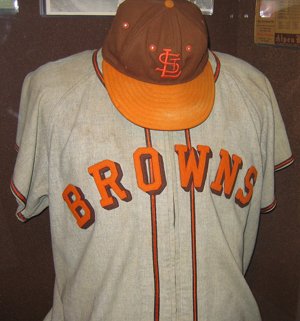
VERY rare vintage 1952 Browns "KM Pro" professional cap issued to Brownies' All-Star ace Ned Garver during the '52 season. Classic, absolutely authentic vintage hat features classic "St L" interlocking logo embroidered on front with orange top button. Near mint, in gorgeous original condition with original KM shipping/storage insert, stating "This Is A Major League Cap." Displays all correct interior tagging with manufacturer's tag sewn in band and company logo and size ["6-3/4"] stamped to right.
The team switched to this all-chocolate brown (panels & bill) style in 1952, and wore it until the move to Baltimore in '54. Garver was traded to the Tigers mid-season in 1952. Purchased through auction of Garver's memorabilia in the late-90's. He provided additional provenance in the form of a beautiful autograph markerd under brim.
This is an extremely scarce Browns cap and likely, the finest known. A tremendous display and representation of era, player and defunct team. This is a tough one to let go of. You will never find a nicer specimen!
VERY rare vintage 1952 Browns "KM Pro" professional cap issued to Brownies' All-Star ace Ned Garver during the '52 season. Classic, absolutely authentic vintage hat features classic "St L" interlocking logo embroidered on front with orange top button. Near mint, in gorgeous original condition with original KM shipping/storage insert, stating "This Is A Major League Cap." Displays all correct interior tagging with manufacturer's tag sewn in band and company logo and size ["6-3/4"] stamped to right.
The team switched to this all-chocolate brown (panels & bill) style in 1952, and wore it until the move to Baltimore in '54. Garver was traded to the Tigers mid-season in 1952. Purchased through auction of Garver's memorabilia in the late-90's. He provided additional provenance in the form of a beautiful autograph markerd under brim.
This is an extremely scarce Browns cap and likely, the finest known. A tremendous display and representation of era, player and defunct team. This is a tough one to let go of. You will never find a nicer specimen!
Click on Photos to Enlarge
Thursday, December 16, 2010
Bob Feller's Connection with Browns & Sportsman's Park
Bob Feller, the Iowa farm boy whose powerful right arm earned him the nickname ''Rapid Robert'' and made him one of baseball's greatest pitchers during a Hall of Fame career with the Cleveland Indians, died on December 15, 2010. He was 92.
The death of Feller takes away the arguably greatest Cleveland Indian of all time. You can read more about Feller's career as told by Browns Fan Club member, Bill McCurdy, at: http://bill37mccurdy.wordpress.com/2010/12/16/farewell-to-rapid-robert/
Remarkably fit until late in life, Feller had suffered serious health setbacks in recent months. He was diagnosed with a form of leukemia in August, and while undergoing chemotherapy, he fainted and his heart briefly stopped. Eventually, he underwent surgery to have a pacemaker implanted. In November, he was hospitalized with pneumonia and Feller was recently released into hospice care.
Bob Feller hit 8 home runs during his major league career. One of these is the answer to a Trivia question - "Who hit the first home run in a night game at Sportsman's Park in St. Louis?" The Answer - Bob Feller on May 24, 1940.
In his first career major league start (just his 7th big league appearance) at the age of 17, he picked up his first win pitching a complete game against the St. Louis Browns winning 4-1 in a game in which he struck out 15. In fact, his first two wins came against the Browns.
Bob Feller hit 8 home runs during his major league career. One of these is the answer to a Trivia question - "Who hit the first home run in a night game at Sportsman's Park in St. Louis?" The Answer - Bob Feller on May 24, 1940.
In his first career major league start (just his 7th big league appearance) at the age of 17, he picked up his first win pitching a complete game against the St. Louis Browns winning 4-1 in a game in which he struck out 15. In fact, his first two wins came against the Browns.
Hank Arft Gone 8 Years Now
Henry "Hank" Arft, a first baseman for the St. Louis Browns from 1948-52, died Dec. 14, 2002, at the age of 80 after a bout with cancer. In 1951, Arft hit .261 with 7 home runs and 42 RBIs, his most productive season in the major leagues. In his career, he hit .253 with 13 home runs. Arft is reported to have written about his days in St. Louis in a St. Louis Browns Historical Society newsletter. At the time Arft played, Bill Veeck was drawing fans to see the team with stunts including Eddie Gaedel, a midget player.
"The Brownie fans were the best ... although Veeck should have owned a circus instead of a ballclub," Arft wrote.
He is also reported to have said, "Who else except a Brownie could say that they played ball with a midget or played in a game that the fans managed?"
Arft retired from baseball in 1953 and became co-owner of Schrader Funeral Home in St. Louis with his wife and brother-in-law.
Sources: AP, Total Baseball
Sunday, December 12, 2010
A Quote from M*A*S*H
Trapper: To go home.
Haskeye: What do they really want?
Trapper: Sex. Except for those baseball perverts.
Saturday, December 11, 2010
Major League Teams Who Have Changed Cities
Major League Baseball
- 1902: Milwaukee Brewers became the St. Louis Browns.
- 1903: Baltimore Orioles became the New York Highlanders and then the Yankees.
- 1953: Boston Braves moved to Milwaukee; this was the first MLB relocation in 50 years.
- 1954: St. Louis Browns moved to Baltimore and became the Orioles.
- 1955: Philadelphia Athletics moved to Kansas City.
- 1958: Brooklyn Dodgers moved to Los Angeles; New York Giants moved to San Francisco. These were the first major league teams on the West Coast; the teams moved simultaneously to facilitate travel for other NL teams.
- 1961: Washington Senators moved to the Twin Cities area and became the Minnesota Twins. Not wishing to alienate Washington and its powerful baseball fans, MLB granted the city a new franchise, also called the Senators.
- 1966: Milwaukee Braves moved to Atlanta.
- 1968: Kansas City Athletics moved to Oakland.
- 1970: Seattle Pilots moved to Milwaukee and became the Brewers. The MLB would grant Seattle a new franchise in 1977.
- 1972: Second Washington Senators moved to Arlington, Texas and became the Texas Rangers.
- 2005: Montreal Expos moved to Washington, D.C. and became the Washington Nationals. The Expos had split time between Montreal and San Juan, Puerto Rico in 2003 and 2004. This was the first MLB relocation in 33 years
Thursday, December 9, 2010
Oldest Brownie Passes Away: George Binks, 96
George 'Bingo' Binks, the oldest Brownie, has died. 7-11-14 to 11-13-10
Here's a link that summarizes his career in baseball.
Surrounded by warm thoughts and prayers from a family that has grown and spread across the United States, George “Bingo” Binks, husband, father, grandfather, great-grandfather, Professional Baseball Player, and master mechanic passed from the earth on Saturday, November 13, 2010 at the age of 96.
George was born on 11 July 1914 to John Binkowski and Teresa Lewandowski, the fifth of six children, in Chicago, Illinois.
To escape the shocking poverty of urban Chicago in the deep years of The Great Depression, George hopped a freight at night that was headed to the Southwest. At dawn in Bloomington, Illinois George saw several hundred kids on a baseball field trying out for a minor league team. At 30 mph, George and a friend jumped from the train, blackened by exhaust soot, into the trackside weeds.
George was number 384 in the line-up. He slept in the dugout for 2 cold April nights in 1933, stuffing newspaper into his clothes for warmth. By the third day, George made the final cut and was paid a few dollars. It was the first time in days that he had enough money to eat. He changed his name to Binks, and later, was given the moniker “Bingo,” for his ability to hit in the “clutch!”
Thus began a baseball career in the Minors that skittered around the country, from
• Monessen Indians in the Pennsylvania State Association to the
• Owensboro Oilers in the Kentucky, Illinois, and Tennessee League to the
• Springfield Indians of the Middle Atlantic League to the
• Tyler Trojans of the East Texas League to the
• Wilkes-Barre Barons of the Eastern League to the
• Cedar Rapids Raiders and Charleston Senators of the Middle Atlantic League to the
• Madison Blues of the Illinois, Indiana, Iowa League to the
• Green Bay Blue Sox of the Wisconsin State League to the
• Milwaukee Brewers of the American Association
When the war broke out, Binks was classified 4-F, "not acceptable for military service," because he was deaf in one ear due to having mastoid trouble in his childhood. Instead of sitting out the war and continuing his career, he sacrificed baseball to work as a machinist in a Studebaker aviation factory in Chicago, Illinois, producing war material for the war effort during 1942 and '43.
Late season 1944 George “Bingo” Binks was swinging a bat for the Brewers and was averaging over .400. So the Washington Senators bought his contract. In ’45 he played first base and outfield. He batted and fielded left-handed. His RBI and doubles were tops on the team and he could have been ‘Rookie of the year,’ In 1947 he was traded to the Philadelphia Athletics, and in 1948 moved to the St Louis Browns. In a five-season career, Binks was a .253 hitter (277-for-1093) with eight home runs and 130 RBI in 351 games, including 112 runs, 55 doubles, 10 triples, and 21 stolen bases.
After his baseball career, George worked at General Motors Locomotive in LaGrange, Illinois, where, over the course of 30 years, he became a master mechanic. Management pleaded with him to stay 2 years past retirement, and he did. The stories from his days fixing the ‘big machines’ at GM were as rich and savory as his stories about Joe DiMaggio, Ted Williams, and Yogi Berra.
George Binks Sr. 7-11-1914/11-13-2010. Late wife Ruth (Naus)and son Gregory. He is survived by his four children, Terrance,(Jenny) Shelbyville, Tn. Randall,(Claire) Mariposa, Ca. Jodee, Strauss/Wolff, Chico, Ca. and George Jr., D.G.,Il.
Ten grandchildren and ten great grandchildren George was a kind, loving, quiet, humorous, gentle man who possessed a deep and abiding testimony about life.
Wednesday, November 24, 2010
Browns/Cardinals Poster Available
A Browns/Cardinal fan has available an artist's drawing picturing various players from the 1944 all St. Louis World Series. If interested in acquiring this, contact Jack Yegge at 636-297-1486. Below are some sample images from the poster.
Click on photos to enlarge.
Thursday, November 18, 2010
1944 Browns Uniform for Sale
The shirt is from the Cooperstown Collection. The pants were made by Ebbetts Field. Hat is a 44 model made also by Cooperstown. Very hard to find now. Comes with stirrup socks and also a late 40s, early 50s Marty Marion four fingered glove in very good condition. Shirt is Large, pants are 34 waist and hat is 7 1/4 +/-.
Asking $325 for everything and includes shipping. That's a firm price.
Contact Ed Williams [bzstar68@hotmail.com]
(Click on Photo to Enlarge)
Asking $325 for everything and includes shipping. That's a firm price.
Contact Ed Williams [bzstar68@hotmail.com]
(Click on Photo to Enlarge)
St. Louis Sports Hall of Fame Dinner Honored STL Sports Stars
In addition to the first St. Louis Browns player to be inducted into the St. Louis Sports Hall of Fame, there were 15 others plus several special achievement awards. Two old time baseball players were inducted and were George Sisler of the Browns and Dizzy Dean of the STL Cardinals. Dean also wore a Browns uniform for a short period and was a broadcaster for the Browns. See the following article about George Sisler.
Pictured below are just a few of the attendees at the head table.
(Click photos to enlarge)
St. Louis Sports Hall of Fame Inducts Browns George Sisler
Gorge Sisler is considered the greatest St. Louis Brown of them all and one of the half-dozen finest first basemen in baseball history. He came to the majors as a left-handed pitcher, but his hitting was too phenomenal to be restricted to a pitcher's schedule. He arrived in St. Louis in 1915, the same year as Rogers Hornsby, and for 11 seasons they were rivals in excellence.
Branch Rickey was his mentor, coaching Sisler at the University of Michigan, where he was an outstanding pitcher. Rickey also counseled Sisler, helping him eventually land a spot with the Browns, a team Rickey would manage after Sisler arrived. Other major league clubs were interested in Sisler. He considered an offer from Pittsburgh, but opted instead to play for the Browns. (Click on photos to enlarge)
Sisler had promise as a pitcher. Still, it was unthinkable not to have his bat in the lineup every day, and his glove at first base - a perennial weak spot for the Browns. In the field, Sisler was fast and graceful, a combination that gave elegance to his execution of plays. He led the American League in assists seven times and his career total of 1,528 assists ranks No.1 on the all-time list. He led the league in double plays three times, including 13 in 1920. Once against Washington, with Joe Judge on third, Sisler anticipated a squeeze bunt by Roger Peckinpaugh. Darting in with the pitch, he fielded the ball before the righthanded Peckinpaugh started down the line. Sisler brush-tagged him and then flipped the ball to catcher Hank Severeid to nip Judge at the plate. The play resulted in two outs on a squeeze bunt.
For his career, Sisler hit .340, tying him for 15th place on the all-time list with Lou Gehrig. At just under 5-foot-11 and a trim 170 pounds, Sisler swung a 42-ounce bat. He often choked up on the handle, but few could handle the lumber as well as Sisler. He recorded 200 hits in six seasons. In 1920, he established a major league record with 257 hits, which still stands. Sisler was also an excellent run producer. He drove in 1,175 runs during his career.
His 1920 season was as mighty a performance as any player has ever produced. Playing every inning of every game, Sisler hit .407. Among his 399 total bases were 49 doubles, 18 triples and 19 home runs. He went hitless in only 23 games and climaxed the season with prodigious averages of .442 and .448 in August and September, respectively. He also drove in a career-high 122 runs and stole 42 bases. In 1922, when the Browns missed winning the American League pennant by one game, Sisler hit safely in 41 consecutive games en route to a .420 average.
He missed the 1923 season with severe sinusitis that infected his optic nerves, which caused double vision. Sisler returned in 1924, signing a $25,000 contract as player-manager. He hit .305 in 151 games. In 1925, he was back on track with 224 hits and a .345 average. In fact, he only had one sub-.300 season in seven after recovering from the illness.
In 1928, the Washington Senators bought Sisler for $25,000, and then moved him to the Boston Braves, where he was reunited with Hornsby. The St. Louis prodigies put on a good show. Hornsby led the league with a .387 batting average, while Sisler hit .340. In 1929 at the age of 36, Sisler ripped 205 hits and batted .326.
After 1930, Sisler drifted into the minors and eventually went into private business, operating printing and sporting goods companies. Rickey recalled him to baseball in the 1940s as a scout and special hitting instructor at Brooklyn and Pittsburgh.
Pictured below is Bo Drockelman, Grandson of George Sisler commenting on the aware from the St. Louis Sports Hall of Fame at their dinner on Tuesday, November 16, 2010.
Branch Rickey was his mentor, coaching Sisler at the University of Michigan, where he was an outstanding pitcher. Rickey also counseled Sisler, helping him eventually land a spot with the Browns, a team Rickey would manage after Sisler arrived. Other major league clubs were interested in Sisler. He considered an offer from Pittsburgh, but opted instead to play for the Browns. (Click on photos to enlarge)
Sisler had promise as a pitcher. Still, it was unthinkable not to have his bat in the lineup every day, and his glove at first base - a perennial weak spot for the Browns. In the field, Sisler was fast and graceful, a combination that gave elegance to his execution of plays. He led the American League in assists seven times and his career total of 1,528 assists ranks No.1 on the all-time list. He led the league in double plays three times, including 13 in 1920. Once against Washington, with Joe Judge on third, Sisler anticipated a squeeze bunt by Roger Peckinpaugh. Darting in with the pitch, he fielded the ball before the righthanded Peckinpaugh started down the line. Sisler brush-tagged him and then flipped the ball to catcher Hank Severeid to nip Judge at the plate. The play resulted in two outs on a squeeze bunt.
For his career, Sisler hit .340, tying him for 15th place on the all-time list with Lou Gehrig. At just under 5-foot-11 and a trim 170 pounds, Sisler swung a 42-ounce bat. He often choked up on the handle, but few could handle the lumber as well as Sisler. He recorded 200 hits in six seasons. In 1920, he established a major league record with 257 hits, which still stands. Sisler was also an excellent run producer. He drove in 1,175 runs during his career.
His 1920 season was as mighty a performance as any player has ever produced. Playing every inning of every game, Sisler hit .407. Among his 399 total bases were 49 doubles, 18 triples and 19 home runs. He went hitless in only 23 games and climaxed the season with prodigious averages of .442 and .448 in August and September, respectively. He also drove in a career-high 122 runs and stole 42 bases. In 1922, when the Browns missed winning the American League pennant by one game, Sisler hit safely in 41 consecutive games en route to a .420 average.
He missed the 1923 season with severe sinusitis that infected his optic nerves, which caused double vision. Sisler returned in 1924, signing a $25,000 contract as player-manager. He hit .305 in 151 games. In 1925, he was back on track with 224 hits and a .345 average. In fact, he only had one sub-.300 season in seven after recovering from the illness.
In 1928, the Washington Senators bought Sisler for $25,000, and then moved him to the Boston Braves, where he was reunited with Hornsby. The St. Louis prodigies put on a good show. Hornsby led the league with a .387 batting average, while Sisler hit .340. In 1929 at the age of 36, Sisler ripped 205 hits and batted .326.
After 1930, Sisler drifted into the minors and eventually went into private business, operating printing and sporting goods companies. Rickey recalled him to baseball in the 1940s as a scout and special hitting instructor at Brooklyn and Pittsburgh.
Pictured below is Bo Drockelman, Grandson of George Sisler commenting on the aware from the St. Louis Sports Hall of Fame at their dinner on Tuesday, November 16, 2010.
(Click on Photos to Enlarge)
Thursday, November 11, 2010
The High School Kid Who Hit it Out of The Park
We know this may be impossible to read, but you can click anywhere on the letter to enlarge it. It's a great piece of history. It's not too often we come across a document of note that is 90 years old. You can also read a featured article about how Lou Gehrig was almost a member of the St. Louis Browns. It's part of the Fall 2010 of Pop Flies, the official publication of the St. Louis Browns Historical Society. You can join by clicking on the BUY NOW bar in the upper right hand corner of the first page of this blog. We will rush a copy to you.
Click on picture below to enlarge.
Click to enlarge to read
Monday, November 8, 2010
St. Louis Auction Featured Browns Memorabilia
Members of the St. Louis Browns Historical Society were on hand at a recent auction for one of the last living World War II-era St. Louis sportswriters/reporter who covered the Browns. Jon Hagar (about age 90) saved every scorecard from the Cardinals and Browns games that he covered. He worked for the St. Louis Star-Times 1943/44 to 1946 and had some assignments from William DeWitt (Browns).
Here are a few of the photos of memorabilia at the auction. (Click on photos to enlarge)
Pictured above (L-R) Dwayne Isgrigg, John Hagar and Emmett McAuliffe (Browns Fan Club)
(Click on photos to enlarge)
Subscribe to:
Posts (Atom)